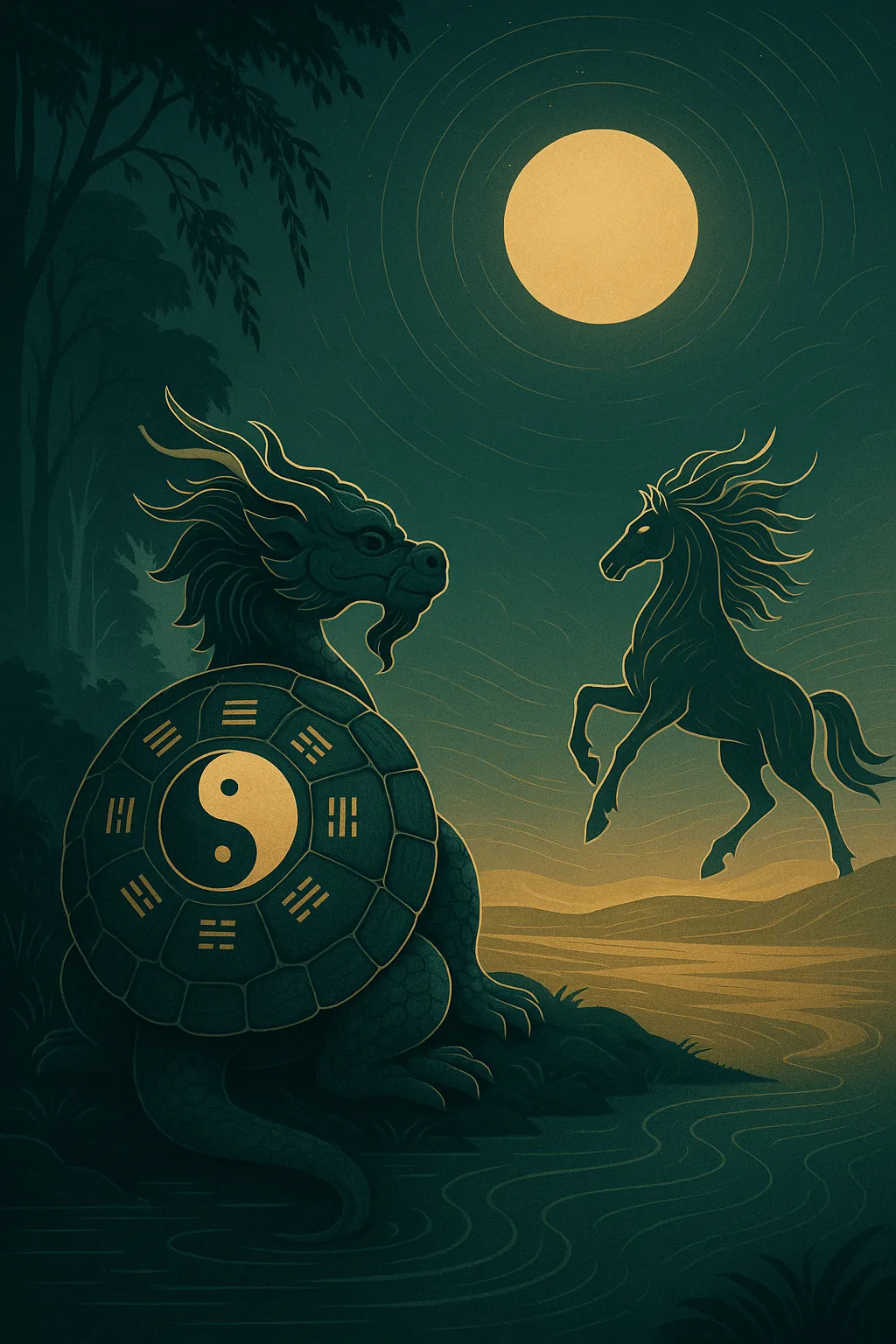
The Dream That Had to Be Deciphered
King Yuan woke up and summoned Wei Ping, the court scholar. After hearing about the dream, Wei Ping turned to the signs of the heavens. He observed the Moon, the position of the handle of the Big Dipper, and other celestial markers. Comparing what he saw with the directions and the Eight Trigrams, Wei Ping concluded that a sacred tortoise had appeared to the king.
The king sent messengers to look for it. They found the fisherman, who confirmed that he had indeed caught an unusual tortoise on that very night.
As the tortoise was being carried back to the court, darkness suddenly fell in the middle of a clear day. Wind rose, thunder rolled, and clouds of five colors appeared above the carriage. When the tortoise was brought before the king, it took three steps toward him and then stepped back. Wei Ping explained that this was its way of thanking the king and asking to be returned home. The king heeded his words and ordered the tortoise to be set free.
The Pattern on the Shell: A Magic Square
But why did the tortoise become a symbol of knowledge about time and the patterns of nature? Here another, even older legend appears: that of Yu the Great and the tortoise that emerged from the Luo River.
According to the legend, its shell bore an unusual pattern of nine groups of marks. It became known as the Luo Shu (洛書, Luò Shū), the “Writing of the Luo River”.
If you arrange the numbers of this pattern in a three-by-three square, you get:
Add up the numbers in any row, column, or diagonal, and the result is always 15. Today such an arrangement is called a magic square.
For people of the ancient world, a regularity like this could serve as a symbol of the order built into the structure of the world. The number five stands at the center, with the other numbers arranged around it to form nine positions. In traditional Chinese cosmology, this pattern was associated with the Nine Palaces, the interplay of yin and yang, and the Five Elements.
The Luo Shu became one of the important symbolic foundations of traditions that study the relationships between time, space, and natural change.
When Knowledge Met the Art of War
Tradition links the further development of Ling Gui Qi Men with the names of well-known Chinese strategists. One of the first is said to be Jiang Taigong (姜太公, Jiāng Tàigōng), also known as Jiang Ziya (姜子牙, Jiāng Zǐyá). His name is associated with the founding of the Zhou dynasty and the development of the art of war.
Jiang Taigong is credited with creating the system of the Eight Gates and Nine Palaces on the basis of the principles of the spirit tortoise. It included seventy-two configurations, which made it possible to examine the relationships between heavenly conditions, earthly space, and human affairs.
Later, at the turn of the 3rd and 2nd centuries BCE, the name of Zhang Liang (張良, Zhāng Liáng), a well-known strategist of the early Han dynasty, is linked to the system’s development. He is credited with simplifying it to eighteen configurations: nine Yang Dun and nine Yin Dun. Yang Dun is used in the period from the winter solstice to the summer solstice, and Yin Dun from the summer solstice to the winter solstice.
This knowledge is also associated with Zhuge Liang (諸葛亮, Zhūgé Liàng), the famous strategist of the Three Kingdoms era. In the legends, his military wisdom and his ability to anticipate how circumstances would develop are explained by his mastery of the methods of Qi Men.
What Remains of the Spirit Tortoise’s Wisdom
The central idea of this story is that time is not uniform. It has its own rhythms, cycles, and patterns. A person exists within these changes and can learn to take them into account when making decisions.
This is the idea YesDao is built on: we use the principles of Ling Gui Qi Men to analyze calendar cycles and the relationships between periods of time. In this way, the ancient image of the spirit tortoise becomes a starting point for a modern view of time, not as a simple sequence of dates but as a system of interconnected change.