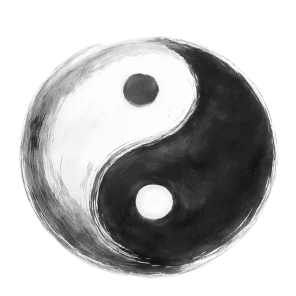
Origins of the Concept
Ideas about Yin and Yang developed in ancient China over many millennia. Their early roots are associated with observations of nature, the alternation of light and darkness, and divination practices. By the first millennium BCE, these ideas were reflected in ancient Chinese texts, including early layers of the Book of Changes (易經, Yìjīng), a tradition associated with divination and the interpretation of change. Over time, observations of opposing states and their relationship developed into a philosophical principle for describing the changing nature of the world.
The Interaction of Yin and Yang
Yin and Yang do not exist in isolation from one another. Their meaning emerges through their relationship: above and below, movement and stillness, rising and descending. Each side is defined in relation to the other.
Their interaction is not fixed. As a process develops, one side may grow stronger while the other weakens. Under certain conditions, change may also lead one state to transform into its opposite.
Four Principles of Yin and Yang
1. Opposition
Opposing aspects may appear in phenomena and processes: movement and stillness, above and below, rising and descending. Their differences help describe the nature of what is happening.
2. Mutual Dependence
Opposing aspects are interconnected and defined through their relationship with one another. One side cannot be fully understood without taking the other into account.
3. Mutual Growth and Decline
The relationship between Yin and Yang is constantly changing. As a process develops, one side may grow stronger while the other weakens.
4. Mutual Transformation
Under certain conditions, the development of one state may lead to a transition into its opposite. This principle emphasizes the changing nature of phenomena and the absence of absolutely unchanging states.
Yin and Yang as a Way of Understanding Change
Yin and Yang are not labels for good and bad, nor are they two isolated forces. They are interconnected categories that help describe differences, relationships, and change.
To understand the state of a phenomenon, it is important to consider not only its individual properties, but also their relationship, the direction of change, and the conditions under which one state transitions into another. In traditional Chinese cosmology, Yin and Yang are among the fundamental ways of understanding the interconnected and changing nature of the world.