How the Trigrams Are Formed
In Chinese cosmological tradition, the emergence of the eight trigrams is described through the following sequence:
Taiji represents primordial unity. From it emerge Yin and Yang, two interconnected principles. Their combinations form the Four Images, and further combinations of lines give rise to the eight trigrams.
Each trigram consists of three lines arranged vertically. A solid line corresponds to Yang, and a broken line to Yin. Different combinations of these lines form the eight symbols.
This sequence reflects the traditional idea that distinctions emerge from unity, and that their combinations give rise to a diversity of forms and processes.
The Eight Trigrams and Their Meanings
Each trigram is associated with a natural image and a characteristic quality.
| Symbol | Trigram | Natural image | Characteristic quality |
|---|---|---|---|
| ☰ | 乾 Qián | Heaven | Strength, firmness |
| ☷ | 坤 Kūn | Earth | Receptivity, following |
| ☳ | 震 Zhèn | Thunder | Movement |
| ☴ | 巽 Xùn | Wind | Penetration |
| ☵ | 坎 Kǎn | Water | Danger, depth |
| ☲ | 離 Lí | Fire | Brightness |
| ☶ | 艮 Gèn | Mountain | Stillness, stopping |
| ☱ | 兌 Duì | Lake | Joy |
These associations help explain why each symbol is linked with particular phenomena and qualities.
For example, Thunder represents movement, while Mountain represents stopping. Heaven symbolizes strength, while Earth suggests the capacity to receive and follow. Water and Fire are contrasting natural images, while Thunder and Wind represent different aspects of interacting natural forces.
The meanings of the trigrams are not limited to literal natural objects. Depending on the context, they can describe more general qualities and processes.
How the Trigrams Relate to One Another
The eight trigrams are not simply a set of eight independent symbols. They have relationships that can be represented through their relative arrangement.
Heaven and Earth, for example, form an opposing pair. Mountain and Lake, Thunder and Wind, and Water and Fire are also viewed as related images with contrasting qualities.
The relationships between the trigrams can be organized in different ways. One arrangement emphasizes correspondence and opposition, while another relates them to directions and the sequence of natural changes. These are known as the Earlier Heaven and Later Heaven arrangements.
The Earlier Heaven Arrangement
Earlier Heaven arrangement (先天八卦, Xiāntiān Bāguà)
The Earlier Heaven arrangement presents correspondences between the trigrams and relationships between opposites.
Four pairs are highlighted in this arrangement:
- Heaven and Earth — opposing principles.
- Mountain and Lake — related natural images.
- Thunder and Wind — contrasting but interacting phenomena.
- Water and Fire — opposites that can balance one another.
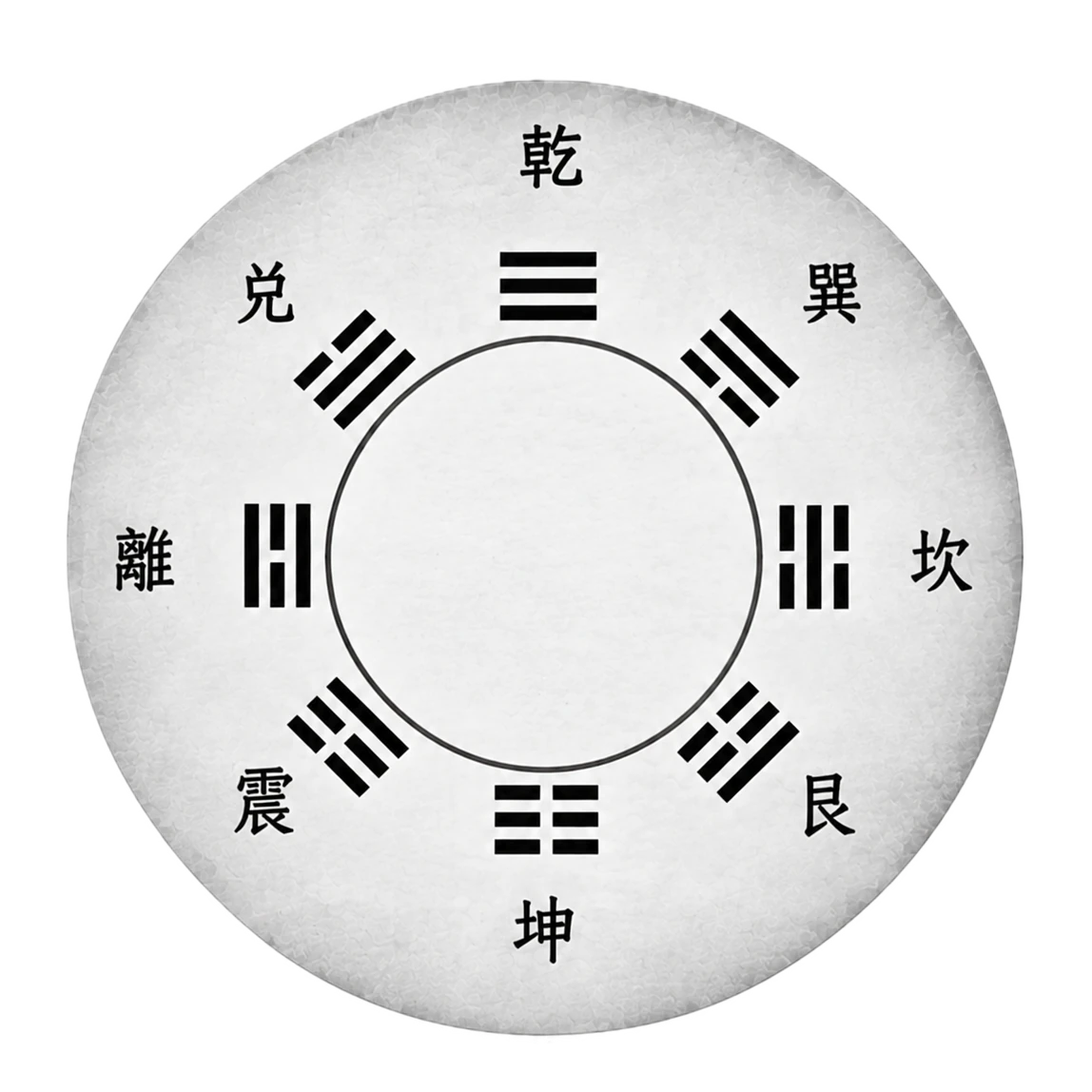
Each pair brings together images that differ in their qualities but remain related. Heaven and Earth represent opposing sides, while Water and Fire show the interaction of different natural principles.
The central emphasis of the Earlier Heaven arrangement is the correspondence between trigrams and the relationships among them.
The Later Heaven Arrangement
Later Heaven arrangement (後天八卦, Hòutiān Bāguà)
Where the Earlier Heaven arrangement emphasizes relationships between trigrams, the Later Heaven arrangement considers them through directions and the movement of natural processes.
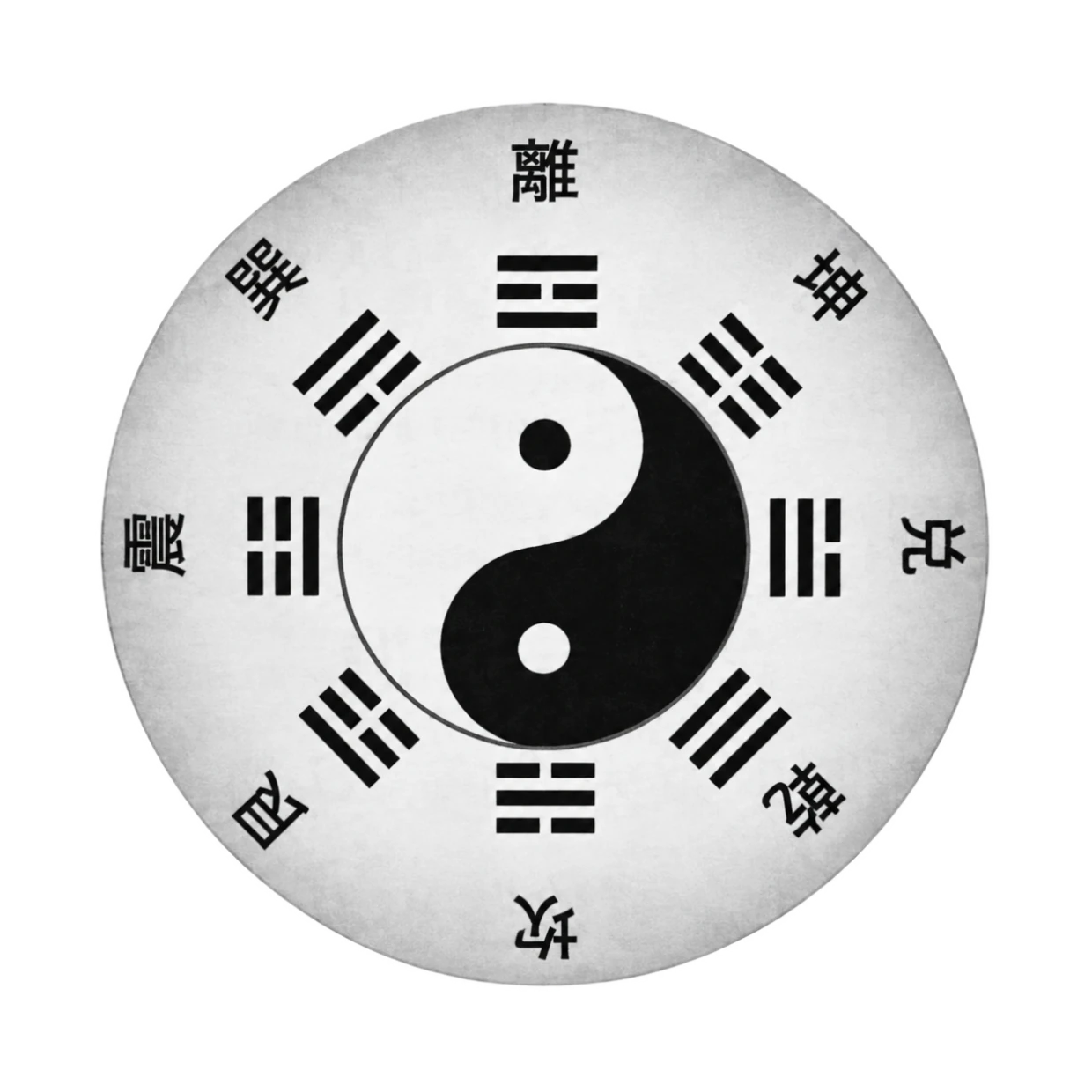
| Symbol | Trigram | Direction | Seasonal association |
|---|---|---|---|
| ☳ | 震 Zhèn | East | Spring, beginning of activity |
| ☴ | 巽 Xùn | Southeast | Continued growth |
| ☲ | 離 Lí | South | Summer, flourishing |
| ☷ | 坤 Kūn | Southwest | Transition toward autumn |
| ☱ | 兌 Duì | West | Autumn |
| ☰ | 乾 Qián | Northwest | Transition toward winter |
| ☵ | 坎 Kǎn | North | Winter |
| ☶ | 艮 Gèn | Northeast | Completion of the winter cycle and beginning of a new one |
The trigrams provide a symbolic way to describe these changes through directions and seasonal stages.
Two Arrangements, Two Perspectives
The Earlier Heaven and Later Heaven arrangements use the same eight trigrams but organize them differently.
The Earlier Heaven arrangement emphasizes correspondences between symbols and relationships between opposites.
The Later Heaven arrangement connects the trigrams with directions, seasonal changes, and the sequence of natural processes.
The two arrangements should not be viewed as simple replacements for one another. They represent different ways of organizing and understanding the same symbolic system.
From Eight Trigrams to 64 Hexagrams
The eight trigrams represent basic combinations of Yin and Yang, but the symbolic system extends beyond them.
Combining two trigrams forms a hexagram consisting of six lines. In this way, 64 hexagrams are formed, each representing a distinct combination of symbols.
The trigrams describe basic natural images and qualities, while the hexagrams extend the system to represent more complex combinations and changes.
The eight trigrams thus form the basis of a broader symbolic system for describing the world.
The Significance of the Trigrams for YesDao
In Chinese cosmology, the trigrams connect Yin and Yang symbols with natural images, directions, and processes of change.
The distinction between the Earlier Heaven and Later Heaven arrangements shows that the same symbols can be organized according to different principles: relationships between opposites or the sequence of natural processes.
These ideas form part of the traditional context for considering time, space, and change. Their specific role in YesDao depends on which elements of this system are used in calendar calculations.