The Principles Behind YesDao
Explore the Chinese philosophical and calendrical concepts behind YesDao and learn how the system uses them to analyze patterns in time.
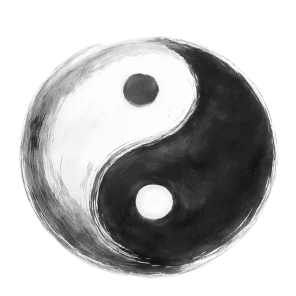
Yin and Yang
Yin and Yang (陰陽, yīn yáng) are fundamental concepts in Chinese philosophy, describing two opposite yet interconnected aspects of phenomena and processes. Their interaction offers a way to understand change in nature and the world.
Learn more about Yin and YangThe Five Elements
Wood · Fire · Earth · Metal · Water
The Five Elements (五行, Wu Xing), also translated as the Five Phases, are a framework in Chinese natural philosophy for describing transformation and interaction. Wood, Fire, Earth, Metal, and Water represent dynamic categories rather than literal substances.
Learn more about the Five ElementsTime Cycles
In the Chinese calendar, time is described through recurring cycles. One of the system’s main tools is the set of Ten Heavenly Stems and Twelve Earthly Branches. Their combinations form a 60-term cycle used to designate years, months, days, and hours and to explore their relationships.
Learn more about time cyclesThe 24 Solar Terms
The 24 Solar Terms (二十四節氣, Èrshísì Jiéqì) reflect the Sun’s annual movement and the seasonal changes associated with it. Together, they mark 24 stages of the annual cycle and help define calendar periods and seasonal transitions.
Learn more about the Solar TermsThe Eight Trigrams
In traditional Chinese thought, the eight trigrams (八卦, Bāguà) are used to describe natural phenomena, their qualities, and their relationships. Each trigram consists of three lines: a solid line represents Yang, while a broken line represents Yin. Different combinations of these lines form the eight symbols.
Learn more about the Eight TrigramsThe YesDao Calendar
The YesDao Calendar is based on the system of the 24 Solar Terms (二十四節氣, Èrshísì Jiéqì), which describe the progression of seasonal phases throughout the year. The color and transparency of each calendar day’s background reflect its position within this cycle, making seasonal transitions and the rhythm of annual change easier to perceive.
Learn more about the YesDao CalendarPersonal Chart
In the Ling Gui Qi Men (靈龜奇門) system, the Personal Chart describes a person’s innate qualities and the circumstances that unfold throughout their life. In YesDao, birth data is used to build an individual context that is taken into account when analyzing calendrical conditions and time periods.
Learn more about the Personal ChartBirth time and calibration
The birth hour defines one of the pillars of your personal chart. Yet a recorded birth time is rarely exact, and clocks do not always match the position of the Sun. That is why YesDao offers calibration — refining your birth-hour branch against the events of your own life.
Learn more about birth time and calibrationLing Gui Qi Men
Ling Gui Qi Men (靈龜奇門) is a system of Chinese calendrical and symbolic methods that forms the foundation of YesDao. In the app, these principles are implemented as computational rules for analyzing dates, time periods, and the relationships between them.
Learn more about Ling Gui Qi MenStars in the Ling Gui Qi Men System
When people first encounter the Ling Gui Qi Men system, they come across many unusual names: Heavenly Thief, White Tiger, Green Dragon, Heavenly Joy, and others.
Learn more about the starsThe Eight Spirits and the Eight Doors
In the Ling Gui Qi Men system (靈龜奇門, Língguī Qímén), various symbolic categories are used to describe temporal conditions. Among them, the Eight Spirits (八神, Bā Shén) and the Eight Doors (八門, Bā Mén) hold a special place. These elements reveal different aspects of the personal temporal context. The spirits are associated with the nature of circumstances and phenomena, while the doors represent temporal states and the possibilities associated with them.
Learn more about the Spirits and DoorsHow to Read the Chart
The YesDao chart shows how calendrical conditions change from one day to the next. It brings together seasonal context, the state of Qi, the character of its expression, and the recommended mode of action. Each point represents a separate day. Its position, colour, and size convey different characteristics of the calculated profile. Considered together, they help explore changes over time and compare adjacent days.
Learn more about the chartHow to Interpret YesDao Results
YesDao goes beyond simply displaying calendar characteristics. It brings together multiple interconnected factors to provide a comprehensive picture of time. The chart illustrates the overall dynamics, the daily description reveals its qualitative characteristics, and AI opens up the possibility of exploring the full depth of the model through personalized queries.
Learn more about interpreting results Back to top ↑